
OpenProse.Talk to our team

Model documentation, checked against written requirements.

This page records one example: a SOFR curve methodology at a fictional bank, checked in Word by an early prototype add-in and assessed separately by AI agents. It gives each recorded result, what the runs do not establish, and what a pilot on your own documents involves.

Three recorded runs in Word: check, update and write.

One model at a fictional bank, three tasks, each with one recorded run against the same three requirement sets: SR 26-2 documentation expectations, a model documentation standard and a documentation voice standard.

SR 26-2 is supervisory guidance on model risk management issued on April 17, 2026 by the Federal Reserve, the FDIC and the OCC, replacing SR 11-7; by our reading, it places generative and agentic AI models outside its scope. OpenProse wrote all three requirement sets: the first is our reading of that nonbinding guidance, and the other two are example house standards.

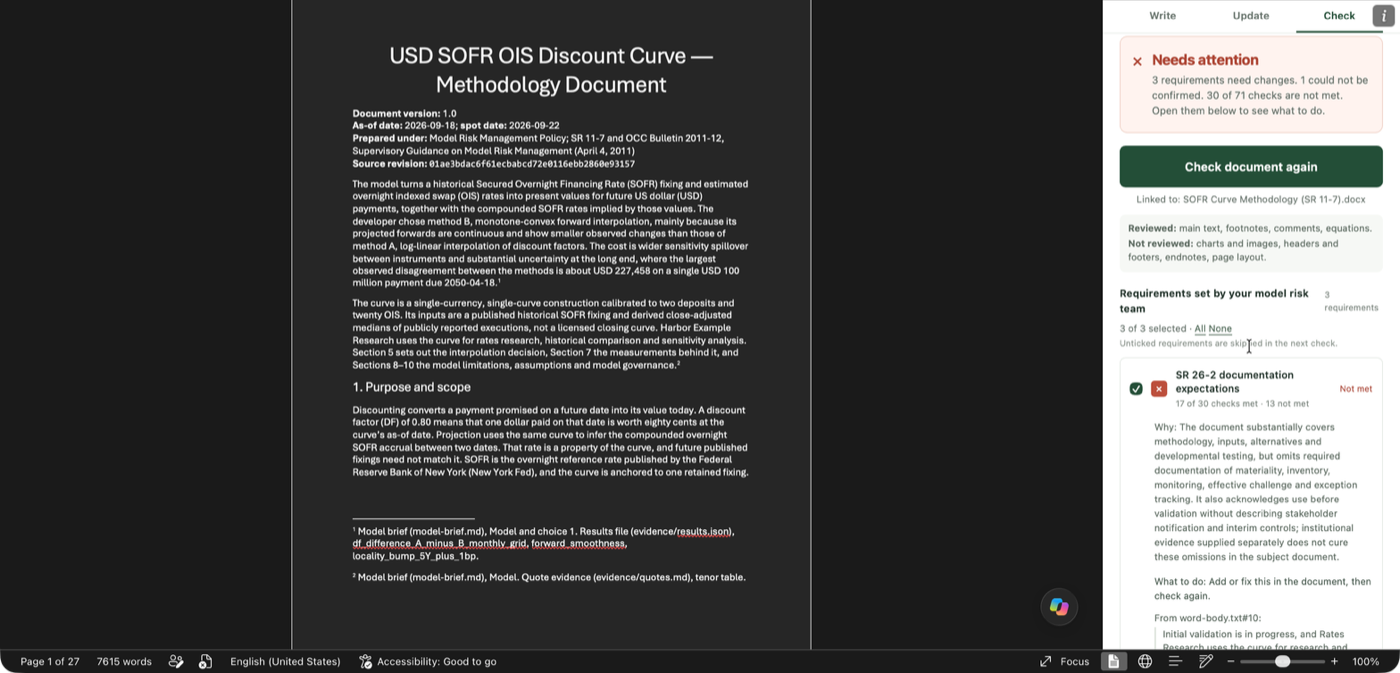
Each figure comes from one recorded run in Word for Mac in November 2026. They show what the add-in reports, not how often it is right. The figure shows the check made at the start of the Update run, on an older document written to SR 11-7; the results for all three tasks follow it.

The document · SOFR Curve Methodology (SR 11-7).docx

USD SOFR OIS Discount Curve — Methodology Document

10. Model governance

[…] The model is subject to validation by MRM prior to use and annually thereafter in accordance with the Model Risk Management Policy. Initial validation is in progress, and Rates Research uses the curve for research and sensitivity analysis in the interim.

Read the full retained excerpt

Document version: 1.0As-of date: 2026-09-18; spot date: 2026-09-22Prepared under: Model Risk Management Policy; SR 11-7 and OCC Bulletin 2011-12, Supervisory Guidance on Model Risk Management (April 4, 2011)

The curve is a single-currency, single-curve construction calibrated to two deposits and twenty OIS. Its inputs are a published historical SOFR fixing and derived close-adjusted medians of publicly reported executions, not a licensed closing curve. Harbor Example Research uses the curve for rates research, historical comparison and sensitivity analysis. Section 5 sets out the interpolation decision, Section 7 the measurements behind it, and Sections 8–10 the model limitations, assumptions and model governance.

1. Purpose and scope

[…] Rates Research uses the curve to value SOFR-discounted USD cash flows and single-curve compounded-SOFR OIS, to compare curves built on historical inputs and to measure sensitivities to the OIS quotes. This document describes the curve built from the inputs as of 2026-09-18. The USD 100 million notional in the numerical examples is a unit exposure chosen for illustration.

· · ·

10. Model governance

[…] The model is subject to validation by MRM prior to use and annually thereafter in accordance with the Model Risk Management Policy. Initial validation is in progress, and Rates Research uses the curve for research and sensitivity analysis in the interim.

The check · as the add-in reported it

Needs attention3 requirements need changes. 1 could not be confirmed. 30 of 71 checks are not met.

Requirements set by your model risk team

SR 26-2 documentation expectationsNot met

17 of 30 checks met · 13 not met

  1. SR-01 Position relative to the guidance scope: met
  2. SR-02 Statement of purpose: met
  3. SR-03 Intended use: met
  4. SR-04 Extension of use: met
  5. SR-05 Materiality from exposure and purpose: not met
  6. SR-06 Shared dependencies: not met
  7. SR-07 Design, assumptions and judgments: met
  8. SR-08 Data selection, quality and relevance: met
  9. SR-09 Comparison of alternatives: met
  10. SR-10 Developmental testing: met
  11. SR-11 Out-of-sample and out-of-time testing: not met
  12. SR-12 Limitations for users: met
  13. SR-13 Use before validation: not met
  14. SR-14 Developmental evidence for conceptual soundness: met
  15. SR-15 Outcomes analysis: met
  16. SR-16 Expert judgment evaluated: met
  17. SR-17 Performance thresholds: met
  18. SR-18 Ongoing monitoring: not met
  19. SR-19 Monitoring frequency and scope basis: not met
  20. SR-20 Response to deterioration and overlays: not met
  21. SR-21 Validation status: not met
  22. SR-22 Lifecycle responsibilities: not met
  23. SR-23 Effective challenge: not met
  24. SR-24 Inventory record: not met
  25. SR-25 Third-party products identified: met
  26. SR-26 Understanding of third-party models: met
  27. SR-27 Third-party monitoring and outcomes: not met
  28. SR-28 Vendor customization: met
  29. SR-29 Recommendations, responses and exceptions: not met
  30. SR-30 Continuity of operations: met
  • Why: Use before validation is explicitly acknowledged and limitations are documented, but stakeholder notification and applied interim controls are not described.

    What to do: Add or fix this in the document, then check again.

    Cited by the run’s SR 26-2 verdict: “Initial validation is in progress, and Rates Research uses the curve for research and sensitivity analysis in the interim.”

Quantitative model documentationNot met

18 of 28 checks met · 10 not met

Model documentation voiceNot met

6 of 13 checks met · 7 not met

Drawn from one recorded run of the early Press add-in in Word for Mac, November 2026. The institution is fictional; the run replays recorded model answers, so it does not show how long a live check takes. OpenProse wrote the requirements the add-in labels as set by your model risk team. The layout and passage highlighting are ours. Findings are judgments for your reviewers, not a compliance determination. See the original screenshot.
What is recorded, what is illustrative and what we matched
  • Recorded: the document text, the counts, each result and each reason. The run’s SR 26-2 verdict cited the governance sentence.
  • Illustrative: the layout, and opening a check to highlight a passage. The add-in lists its findings; this highlighting is ours.
  • Matched by us: the passages shown for SR-05 and SR-02, chosen because the recorded reasons refer to them.

The 30 SR 26-2 checks are our reading of nonbinding guidance; the other two sets are example house standards.

Check

A finished methodology document

All 30 of our SR 26-2 documentation checks met, which concerns documentation readiness only, with 24 of 28 model documentation checks and 8 of 13 documentation voice checks. Findings that quote a passage can be added to the document as Word comments.
Update

An older document written to SR 11-7

17 of 30 SR 26-2 checks met. After the proposed tracked changes were accepted and the document was checked again, 25 of 30. Four remained not met and one unresolved; most need facts only the bank can supply.

Write

A first draft from the model’s code, data, results and notes

Written into the bank’s template, the draft met 29 of 30 SR 26-2 checks, 24 of 28 and 8 of 13. Where the files could not answer a question, it left a Word comment for the owner.

A separate evaluation outside Word: what a second agent found.

In October, one document was assessed twice. A second AI agent found a material error. An earlier version of the add-in, checking a Word copy of the same document two weeks later, did not. R-40 and F-01 are that demonstration’s own numbers for the requirement and the finding.

The requirement · R-40 · documentation requirements

A number occurring in a source is insufficient if its subject, denominator, interval or meaning differs.

The document · Section 7.4 · Table 11 · maximum change in discount factors

Change versus baseAB
Fixed leg interpreted Act/365F rather than Act/3600.005000700.00500142

The finding · F-01 · material

The row is labeled as a switch to Act/365F, but its figures come from a different change to the inputs. The numbers are real; the label describes a test that was not run.

Inspect the calculation

The code keeps the Act/360 instruments and multiplies each quote by 365/360. Reading an unchanged coupon under Act/365F is equivalent to multiplying by 360/365, the reciprocal. The assessment cites lines 287–291 of the model’s bootstrap script.

Keep the numbers, describe the calculation that produced them, and mark the day-count sensitivity as unresolved.

How each evaluation was run

The Prose demonstration

October 12, 2026

We supplied three layers of written requirements, public market data and a fictional bank’s conventions. One AI agent wrote a twelve-section SOFR methodology from them and reported every requirement met.

A second AI agent assessed the document against the same requirements and rated it partly fulfilled: one day-count sensitivity was labeled as a test the calculation had not performed.

Read the document and the assessment

The run page calls this an “independent assessment”. It was made by a second AI agent and is not an institutional validation.

The Press trial in Word

October 27, 2026 · Word for Mac

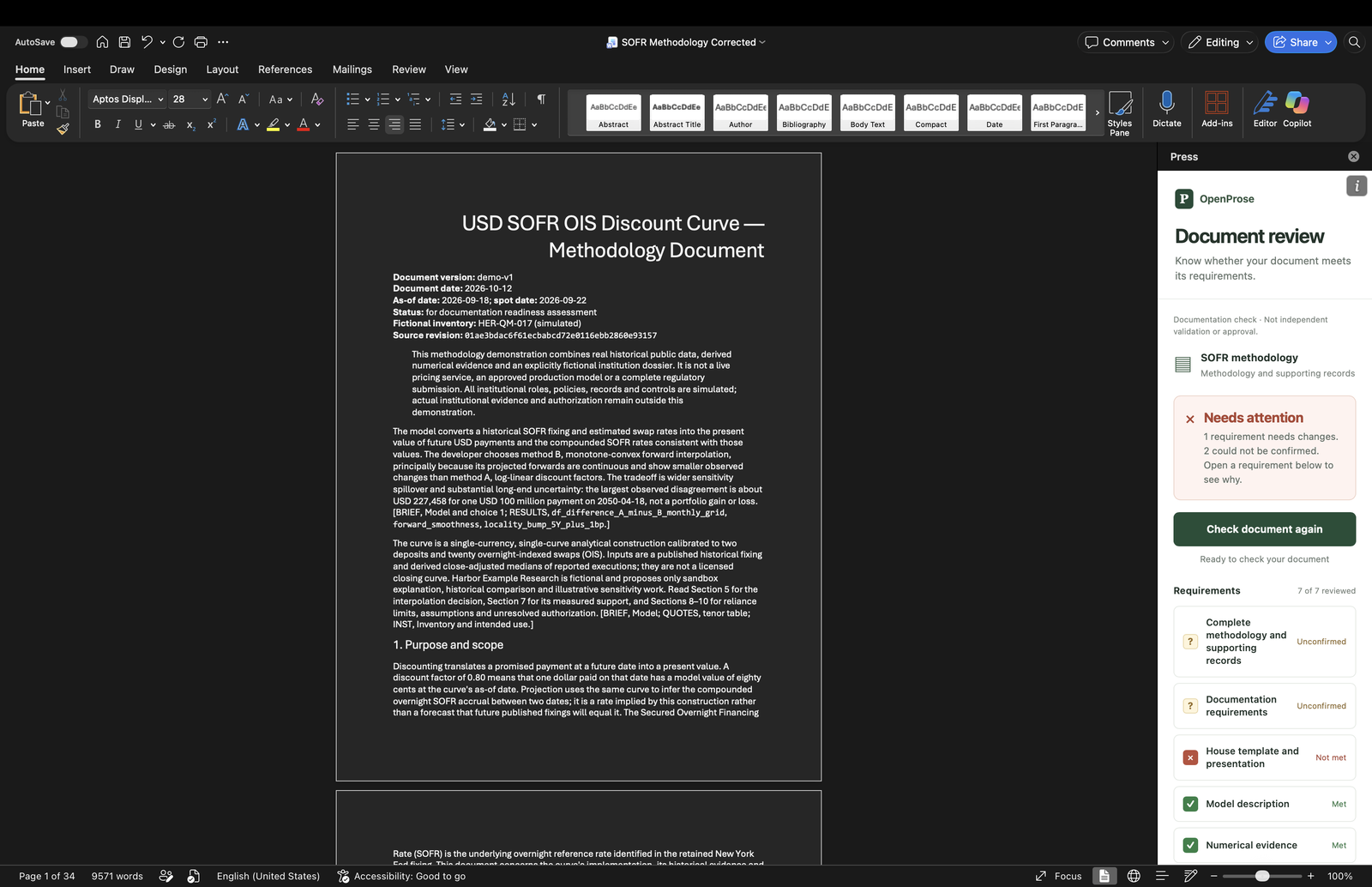
The early Press add-in checked a Word copy of the same document against seven requirements. Four were met, one was not met and two were unresolved. It caught an abbreviation used before it was defined.

It had not been given the earlier assessment, and it marked numerical evidence as met with the mislabeled row still in the document.

How Press works
The October add-in’s seven results, and the recorded screenshot
The October add-in’s seven results
Model descriptionPurpose, scope, dated inputs, calibration, assumptions and limits are identified.Met
Numerical evidenceMeasures, units, dates and populations are defined.Met
Claim evidenceMaterial claims carry specific evidence locators, and the limits of each check are stated.Met
Institutional factsSimulated facts are attributed to the fictional dossier, and missing institutional information is marked.Met
House template and presentationIQR was used in Section 4 before being spelled out in Section 7.3.Not met
Complete methodology and supporting recordsThe captured equations were distorted, so the check could not establish that they present the required relationships.Unresolved
Documentation requirementsThe Word text did not preserve readable mathematical relationships or retrievable reference links.Unresolved
The recorded Press check beside a SOFR methodology document in Microsoft Word: four requirements met, one not met and two unresolved.
The October 27 recorded check. The institution is fictional, and no edits were made to the document.

The two checks were not a like-for-like comparison: the add-in worked from a plain-text copy, with the requirements grouped differently. The trial shows a requirement-by-requirement check running inside Word. We have not established whether the current add-in would catch the same error. It does not establish accuracy, time saved, model validity or institutional approval, and the judgment remains with your reviewers.

How the requirements are layered.

The demonstration composed its requirements from three layers, so the shared parts can be reused and the specific parts stay small. Information only the institution can supply is left for its team.

  1. Shared requirements

    What any model documentation needs to explain and support.

  2. House conventions

    The institution’s template, terminology and evidence requirements.

  3. The particular model

    Its technical brief, sources and worked example.

An illustration: what you ask for, and what comes back

An illustration of the workflow, not a recorded result. The requirements behind it are published in our open-source library. Quant library · Markdown

Example request

Document this model from the approved sources. Use our house requirements and identify what still needs review.

Expected deliverable

Model record

  • Methodology, assumptions, and supporting sources
  • Missing evidence and open review questions
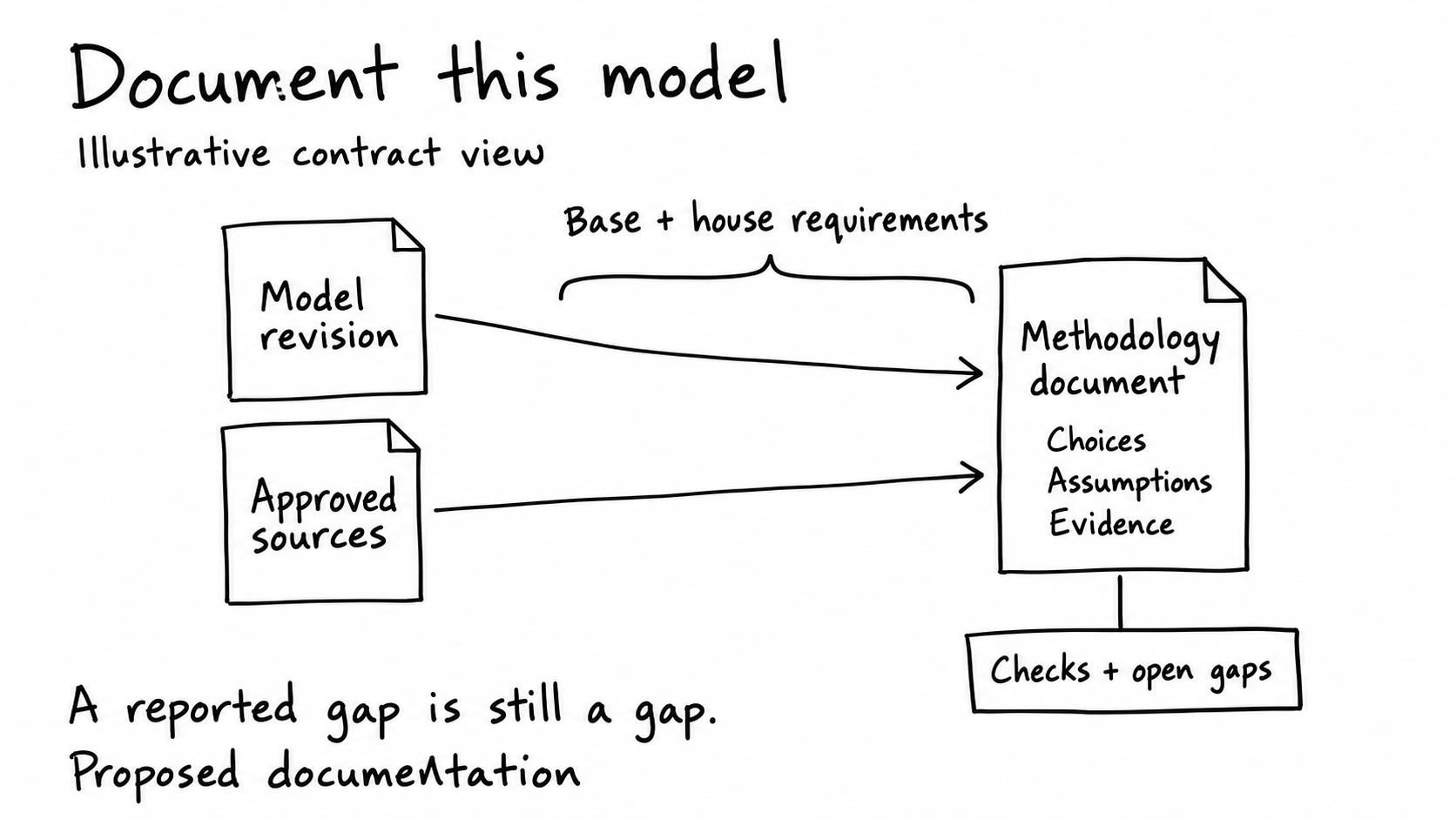
A view of the requirements
A model revision and approved sources feed a methodology document under base and house requirements. Choices, assumptions and evidence connect to supporting checks and open gaps. A reported gap remains a gap; the documentation is proposed.
Illustrative view: model sources, requirements and supporting checks shape a proposed methodology document.

What a pilot involves.

A paid pilot starts with an agreed scope: one preparation or review task on your own material, and the evidence that would make the evaluation useful to you.

  1. Choose

    Choose one document, its approved sources and the standards your team applies. Agree how its data is handled and who has access before any institutional material is supplied.

  2. Run

    Run the paid pilot on that material. Agree the questions to assess and how your experts will judge findings, omissions and unresolved items. Validation and approval stay with the people responsible.

  3. Decide

    Compare useful findings, missed issues, false alarms, review effort and cost, then decide whether engineering work should follow.

Bring us one model document.

The first conversation is about your work: which document takes your team the most effort, what a useful result would be, and whether a paid pilot is worth doing.

Talk to our team.

The first conversation is about your work: one representative workflow, what a useful result would be, and whether a paid pilot is worth doing. You do not need to send any documents first.

Scheduling is provided by Cal.com. Loading the calendar connects your browser to Cal.com, and the booking details you submit are sent to Cal.com.